
Why gold remains a pillar of the global monetary system, how debt, credit, and central banks explain its resurgence, and why it acts as a constant in the face of currency devaluation.
Gold generates neither yield, nor interest, nor dividends. It is based on no contract, no promise of repayment, and no future financial cash flows. And yet, it remains at the heart of the global monetary system.
For several millennia, gold has endured economic cycles, wars, political collapses, and monetary transformations without ever losing its essential function: preserving value over time. Where currencies are born, evolve, and disappear, gold remains.
In a modern economy dominated by debt, credit, and institutional trust, this permanence is not a detail. It is precisely what makes gold unique.
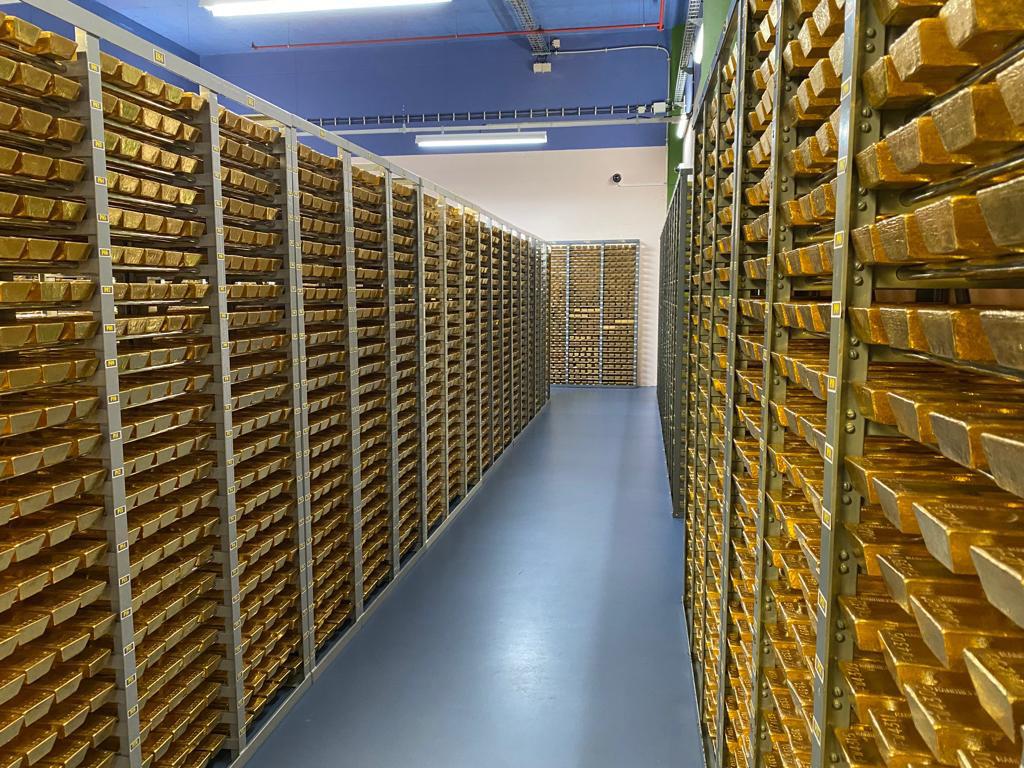
Gold as a monetary constant, not a speculative asset.
One of the most common misconceptions is to say that gold “goes up.” In reality, gold does not rise. It remains relatively constant in real value. What depreciates are the currencies in which it is priced.
When the price of gold increases in dollars, euros, or yen, it primarily reflects the loss of purchasing power of those currencies. Gold acts as a monetary mirror. It reveals the gradual erosion of currencies caused by inflation, public debt, and monetary creation.
All major modern currencies have lost a significant portion of their real value over the long term. This devaluation is not accidental. It is structural. It allows governments to finance their deficits and reduce the real burden of their debt. Gold, by contrast, does not participate in this mechanism.
This is why gold has historically been considered a monetary asset before being a financial asset. Institutions such as the World Gold Council regularly emphasize that gold plays a distinct role in the economic system, different from equities, bonds, or real estate.
The global economy built on credit.
The current economic system is built on continuous credit expansion. Governments finance their spending through borrowing, businesses invest using credit, and households consume by anticipating future income. This model functions as long as confidence is maintained and interest rates remain compatible with debt servicing.
However, global public debt has now reached unprecedented levels in peacetime. Budget deficits have become structural. Bonds reaching maturity are refinanced through new issuances, often under conditions that are increasingly sensitive to inflation and interest rates.
In this context, the stability of the system depends directly on central banks. Their role is no longer limited to controlling inflation, but extends to ensuring the overall sustainability of credit.
Public debt, inflation, and bond market fragility.
Government bonds are often perceived as risk-free assets. This perception rests on an implicit assumption: that states will always honor their obligations in real terms.
History shows, however, that when debt becomes excessive, governments have several levers at their disposal. They can raise taxes, restructure the debt, or, more subtly, allow inflation to reduce the real value of repayments. This last option is the one most frequently used.
In a high-debt environment, bonds therefore become exposed to three major risks: the loss of purchasing power through inflation, the monetization of debt by central banks, and the long-term loss of fiscal credibility.
Gold is entirely outside this dynamic. It is no one’s liability. It involves no future repayment. It is not affected by a state’s solvency or by its budgetary choices. This independence explains why it preserves its value when credit systems come under strain.
Why central banks are returning massively to gold.
Since the late 2000s, a profound shift has taken place. Central banks have once again become net buyers of gold. This trend has intensified in recent years and reflects a major strategic evolution.
Gold offers central banks something that very few assets can provide: the complete absence of counterparty risk. It does not depend on an issuer, a payment system, or another state. It is universally recognized and can be held physically within national territory.
Institutions such as the People’s Bank of China and the Central Bank of Russia have significantly increased their gold reserves in order to reduce their dependence on foreign currencies, particularly the US dollar.
When gold was considered useless
This return to gold stands in sharp contrast to the period of the 1990s and the early 2000s. At that time, gold was widely regarded as an archaic asset. Government bonds offered positive real yields, globalization appeared irreversible, and geopolitical stability was taken for granted.
Many Western central banks therefore sold a significant portion of their gold reserves to strengthen their bond portfolios. This strategy was based on a central assumption: that sovereign assets were politically neutral and legally inviolable.
That assumption was about to be profoundly challenged.
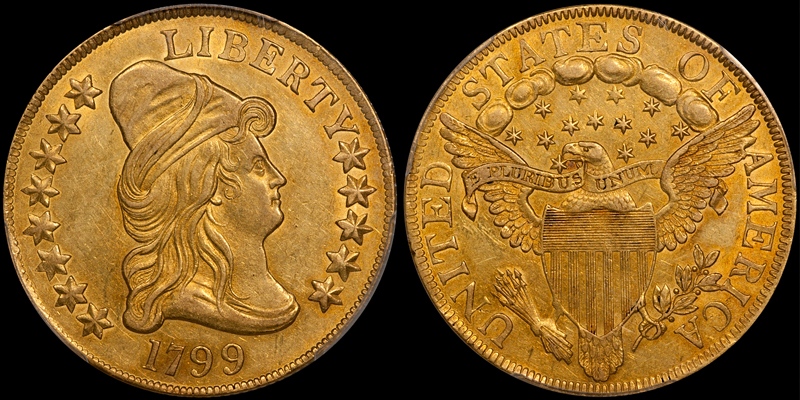
Gold in the face of geopolitical fractures, global uncertainty, and the physical limits of supply.
After decades marked by relative monetary and geopolitical stability, the global economy is entering a different phase. The certainties that supported the international financial order are gradually eroding. This regime shift largely explains gold’s return to the center of monetary and wealth strategies.
Gold does not react to an isolated event. It reacts to the accumulation of fragilities.
The freezing of Russian assets and the end of financial neutrality.
The freezing of Russian foreign exchange reserves held abroad marked a historic turning point. Through a coordinated decision, the United States and its allies rendered hundreds of billions of sovereign assets inaccessible, via the U.S. Department of the Treasury and Western financial systems.
For the first time on this scale, a fundamental principle of the international monetary system was called into question: the neutrality of reserves.
Until then, reserve currencies and sovereign bonds were perceived as politically safe, regardless of diplomatic tensions. This episode demonstrated that the security of a financial asset now depends on geopolitical alignment.
Gold, when held physically within national territory, escapes this logic. It cannot be frozen, blocked, or invalidated by a foreign decision. This reality has profoundly altered risk perception within central banks.
The return of geopolitical risk as a central economic variable.
For several decades, globalization created the illusion of a world stabilized by economic interdependence. Conflicts appeared costly and therefore unlikely. Markets gradually absorbed this view as a given.
That interpretation no longer matches reality.
Modern wars are no longer confined to battlefields. They manifest through sanctions, trade restrictions, supply disruptions, currency wars, and financial pressure. Each conflict becomes a global economic shock.
In this context, geopolitics once again becomes a central variable in economic analysis. It influences energy, commodities, currencies, capital flows, and financial stability. Traditional financial assets, however, are poorly equipped to absorb this structural uncertainty.
Gold as protection against systemic unpredictability
Gold does not protect against a specific scenario. It protects against what cannot be anticipated.
Equities are sensitive to economic cycles. Bonds depend on fiscal credibility and on decisions made by central banks, notably the Federal Reserve. Currencies rely on political and monetary stability.
Gold, by contrast, depends on no future promise. It does not rely on growth, fiscal discipline, or international cooperation. It simply exists. It is this independence that explains why it regains importance when the world becomes less predictable and more fragmented.
A physically limited, slow, and rigid supply.
To this geopolitical dimension is added a fundamental factor that is often underestimated: supply.
Gold cannot be created by political decision. It must be extracted from the ground, processed, refined, and stored. Economically viable deposits are rare, increasingly deep, and costly to develop. Bringing a new mine into production generally takes between ten and fifteen years.
Even a sharp rise in the price of gold does not allow global supply to increase quickly. Geological, environmental, energy, and regulatory constraints make any rapid expansion impossible.
Unlike currencies, gold cannot be diluted. When demand rises in a context of uncertainty, the adjustment occurs almost exclusively through price.
Debt, monetary creation, and the role of gold as an anchor.
The continuous increase in public and private debt places growing pressure on monetary systems. The higher debt rises, the more authorities must arbitrate between financial stability and monetary discipline.
In this context, monetary creation becomes a recurring tool. It helps maintain system liquidity, but at the cost of a gradual erosion in the value of currencies. This dynamic is rarely perceived immediately. It operates slowly, but persistently.
Gold is not affected by these mechanisms. It does not depend on a state’s solvency or its ability to refinance its debt. It cannot be created to resolve a budgetary imbalance. This neutrality explains why it acts as an anchor when currencies are subjected to structural pressures.
Gold as a systemic insurance, not a bet.
Gold is not a performance asset. It is a resilience asset.
Central banks do not buy gold to beat the markets. They buy it to reduce their exposure to risks they do not control. They implicitly acknowledge that the current monetary system is more indebted, more politicized, and more unstable than it was thirty years ago.
In a world marked by geopolitical fragmentation, rising debt, and persistent economic uncertainty, gold plays a discreet but fundamental role. It promises nothing. It depends on no one. It protects against the excesses of the system.
Gold in a modern wealth perspective.
Gold is neither a relic of the past nor a speculative bet on the future. It is a tool of continuity in a world of disruptions.
Its value lies not in what it yields, but in what it preserves. In an economy built on debt, trust, and monetary creation, this function becomes central.
This is why central banks accumulate it, institutional investors reconsider it, and gold gradually regains its place in a thoughtful wealth allocation.
Because it does not depend on any state or any political alliance.
Yes. It demonstrated that foreign currency reserves can be politicized.
No digital asset combines physical scarcity, political neutrality, and the absence of counterparty risk.
Because extraction is slow, costly, and subject to physical and regulatory constraints.
I invite you to read my article on inflation to better understand what it is.
2 Comments